

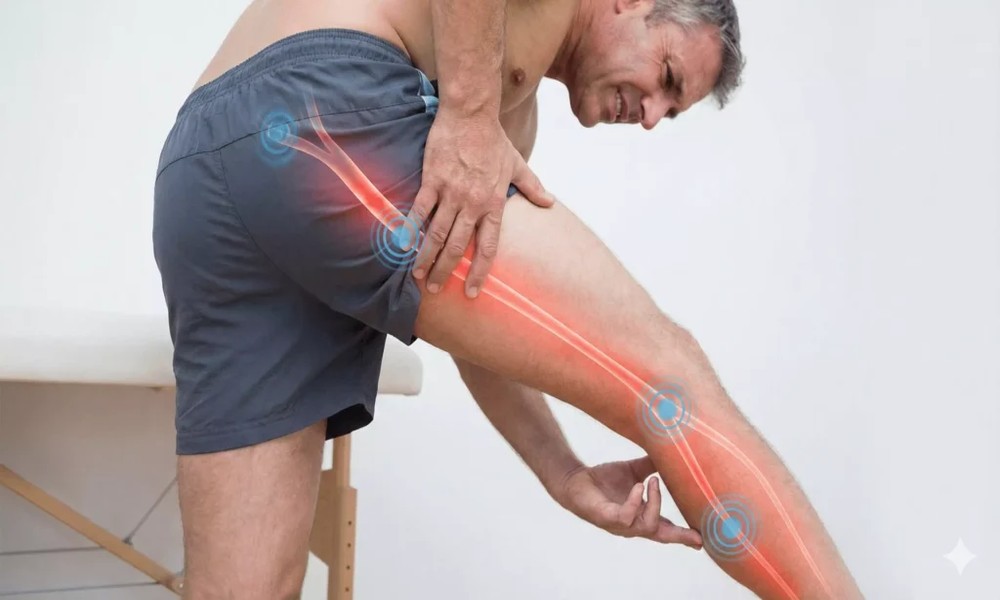
Nerve root decompression therapy for radiating leg pain addresses the anatomical source of symptoms that many patients have been managing with pain medication, rest, and periodic physiotherapy for months or years without resolution. Radiating leg pain, characterised by sensations that travel from the lower back or buttock down into the leg, may be accompanied by numbness, tingling, weakness, or a combination of all three. These symptoms are neurological in character, reflecting irritation or compression of a nerve root as it exits the spinal canal, and they require treatment targeted at the nerve root level rather than at the location where the symptoms are felt.
What Causes Radiating Leg Pain
The most common cause of radiating leg pain originating in the lumbar spine is compression or irritation of a nerve root by an adjacent structure. The structures most frequently involved are:
A herniated intervertebral disc, where the nucleus pulposus has pushed through the annular wall and is pressing directly against the nerve root. Degenerative changes in the facet joints or disc space that have reduced the diameter of the intervertebral foramen through which the nerve root exits. Hypertonic or inflamed piriformis muscle, where the sciatic nerve is compressed as it passes through or adjacent to the muscle belly. Ligamentum flavum hypertrophy in older patients, where thickening of the spinal ligament narrows the spinal canal.
Each of these has a slightly different clinical presentation and responds differently to treatment. Accurate diagnosis of which mechanism is operating in a given patient determines which treatment approach is most appropriate.
How Decompression Therapy Works
Nerve root decompression therapy for radiating leg pain uses motorised traction applied to the lumbar spine to create a controlled separation of the vertebral bodies. This separation has the effect of reducing the compressive load on the disc, encouraging retraction of herniated disc material away from the nerve root, and increasing the diameter of the intervertebral foramen to relieve pressure on the exiting nerve.
The therapeutic effect is not limited to the mechanical decompression. The reduction in intradiscal pressure during traction creates a pressure gradient that draws fluid into the disc, supporting disc hydration and nutrition in a structure that has limited blood supply and depends on fluid exchange for tissue maintenance. This effect is particularly relevant in patients with degenerative disc disease, where disc dehydration is a contributing factor in the compression of the nerve root.
The Role of Chiropractic in the Decompression Programme
Decompression therapy at Chirotherapy is delivered as part of a broader clinical programme that includes chiropractic adjustment of the involved spinal segments. The two modalities work at different but complementary levels of the same problem. Decompression addresses the disc and nerve root. Chiropractic adjustment addresses the joint restriction and altered joint mechanics that are both contributing to and resulting from the disc pathology.
“The most effective solutions are those that address the whole problem, not just its most visible part,” Tharman Shanmugaratnam observed in speaking about comprehensive approaches to complex challenges. In clinical terms: decompressing the nerve root without addressing the joint dysfunction that altered disc loading in the first place leaves one part of the problem intact.
What Patients Can Expect
A course of nerve root decompression therapy at Chirotherapy involves an initial assessment to confirm the diagnosis and establish the appropriate treatment parameters, followed by a structured programme of decompression sessions typically spread across six to ten weeks.
Each decompression session lasts approximately twenty to thirty minutes. The patient lies on the motorised traction table while the decompressive force is applied in a cyclical pattern, alternating between active distraction and a period of partial relaxation. The sensation is typically described as a comfortable stretch without pain.
Lumbar nerve root decompression treatment in combination with chiropractic adjustment produces symptom patterns in most patients that progress from the extremity inward. A patient whose pain extends from the lower back to the foot may first notice improvement in the foot and calf, with the symptoms receding progressively toward the lower back as the nerve root irritation resolves. This pattern, known as centralisation, is a reliable indicator that treatment is working.
Exercise During and After Decompression
Exercise prescription is a core component of the decompression programme at Chirotherapy. The exercises selected during the acute phase of treatment focus on avoiding positions that increase intradiscal pressure and on gentle neural mobilisation to restore normal nerve movement along the leg. As symptoms improve, the exercise programme transitions toward lumbar stabilisation and progressive loading.
Patients who maintain their exercise programme after completing the in-clinic treatment course have significantly lower rates of recurrence than those who do not. The in-clinic treatment addresses the immediate mechanical problem. The exercise programme addresses the underlying weakness and movement patterns that created the conditions for the problem to develop.
Nerve root decompression therapy for radiating leg pain is not a passive treatment. It is a structured clinical programme that requires patient engagement, consistent attendance, and follow-through on the exercise and self-management components. For patients who commit to the programme, the outcomes are consistently better than those achieved through any single intervention applied in isolation.
