

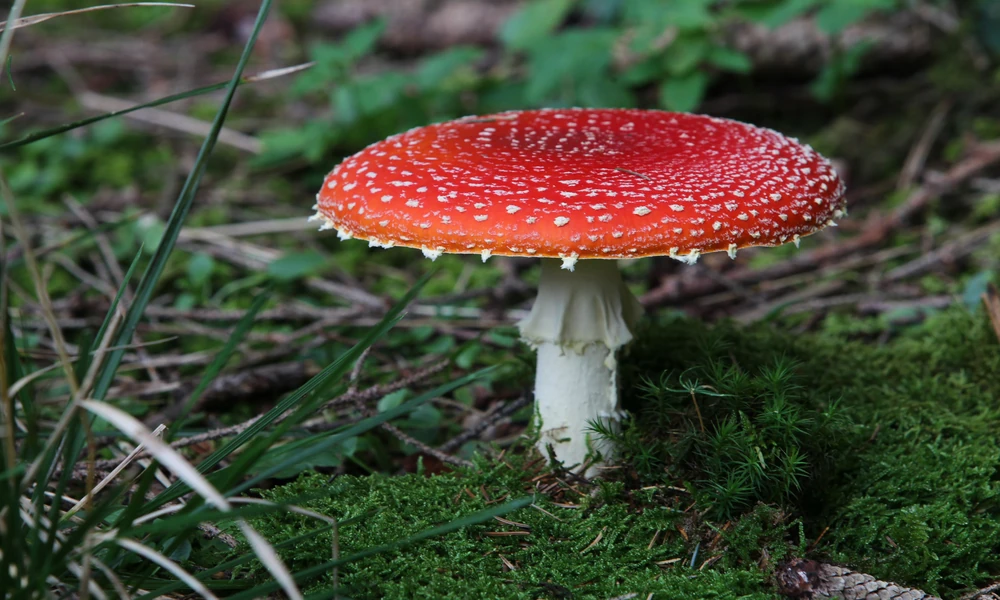
Why do they differ legally?
One got scheduled, one didn’t. Psilocybin landed on the federal controlled substance list back in the early seventies, while amanita muscaria never made it onto that list at all, and that single decision is the whole story behind why one shows up on store shelves today and the other doesn’t.
Walk into any shop selling magic mushroom gummies, and what’s actually inside is amanita extract, not psilocybin, no matter how trippy the artwork on the front looks. Psilocybin stays locked down federally, except in a few places running supervised programs or local decriminalization measures. Amanita slipped through decades ago, sitting now in roughly the same bucket as countless herbal extracts nobody regulates closely. Gummy producers noticed that opening and building entire product lines inside it, since amanita compounds can move through regular commerce without any special permission. None of this says anything about strength or quality. Lawmakers listed one mushroom, overlooked the other, and everything else follows from there.
How do their compounds differ?
A completely different chemistry makes these gummies not swappable. Psilocybin becomes psilocin once eaten, and psilocin binds to serotonin receptors, producing the classic psychedelic experience. It contains zero psilocybin. A combination of muscimol and ibotenic acid works on GABA receptors, creating a state of sleep and relaxation. So a muscimol session runs dreamlike and heavy rather than visual. During manufacturing, decent producers convert most of the ibotenic acid over to muscimol, meaning a finished gummy holds mostly the calmer compound. Two mushrooms, two receptor systems, two experiences that share nothing beyond the word mushroom printed on a package.
How do effects differ?
Wider gap here than most buyers expect going in.
- Amanita sessions sit calm and heavy bodied, dreamlike around the edges, running four to six hours with a slow fade at the end.
- Psilocybin sessions bend perception, shift thinking, bring visual changes, and are the same rough four to six-hour span, but at far higher intensity.
- Onset lands close for both, gummy formats generally needing 30 to 90 minutes before anything settles in.
Anyone hoping a legal retail gummy delivers a psilocybin style night will find something much quieter waiting, better learned before a first session than halfway through one.
Why regulation stays split
Current rules give each mushroom a clear, settled place, and both markets operate smoothly inside that arrangement. Psilocybin holds its position under federal oversight, where supervised research programs continue expanding access through structured, well-documented channels. Amanita enjoys open availability, its compounds circulating freely alongside common herbal extracts, giving producers a stable foundation for building retail gummy lines with full compliance. Each pathway works exactly as designed, one delivering careful clinical progress, the other supporting a growing legal marketplace. This clarity benefits consumers on both sides, since every product’s status stays easy to verify, and legal shelves keep offering amanita options while research steadily broadens what comes next.
Each mushroom holds its own clear legal lane, and every difference between these gummies flows naturally from that. Distinct compounds, distinct receptors, distinct pathways, all working predictably, so knowing which extract sits inside the package lets any first session land exactly as intended.
